
The Cardiology Blueprint: How Health Compiler and Elation Health Simplified MIPS for a High-Volume Practice
A cardiology clinic with three MIPS-eligible clinicians and roughly 4,000 patients had a reporting problem it could not quite pin down. The clinical care was strong. Clinicians were documenting thoroughly in their Elation Health EHR. But when MIPS scores came back, the numbers did not match the effort going in.
Their reporting process was largely manual. Staff pulled data from Elation, organized it in spreadsheets, and calculated performance by hand. It was time-consuming, and it left the practice with limited visibility into how individual clinicians were tracking on specific measures throughout the year. By the time they reviewed their scores, there was not much room to adjust before the performance period closed.
The practice knew the care was there. They needed the reporting to reflect it. That is what led them to bring Health Compiler into the workflow alongside Elation.
The Documentation Was There. The Reporting Was Not Using All of It.
The clinicians at this clinic were capturing the relevant information in their Elation notes: medication management decisions, treatment rationale, referral discussions, follow-up plans.
The challenge was that a good portion of this lived in unstructured clinical narratives rather than in discrete coded fields. That is not unusual. Clinicians document in the way that makes clinical sense, and Elation supports that flexibility well. But many reporting tools are built to read only structured data, which means documentation that exists in a progress note or assessment can go unrecognized in the MIPS calculation even though the clinical action was taken.
The result was a gap between what the practice was doing and what the reporting reflected.
How Elation and Health Compiler Worked Together
The integration was straightforward. Health Compiler connected to the practice's existing Elation EHR without requiring any migration or workflow changes. Clinicians continued documenting the way they always had.
What changed was how that documentation got used. Health Compiler's engine reads both structured and unstructured clinical data from Elation, which meant information that had previously been missed in measure calculations, like beta-blocker therapy decisions in a progress note or a cardiac rehab referral discussed in an assessment, now contributed to the practice's MIPS performance.
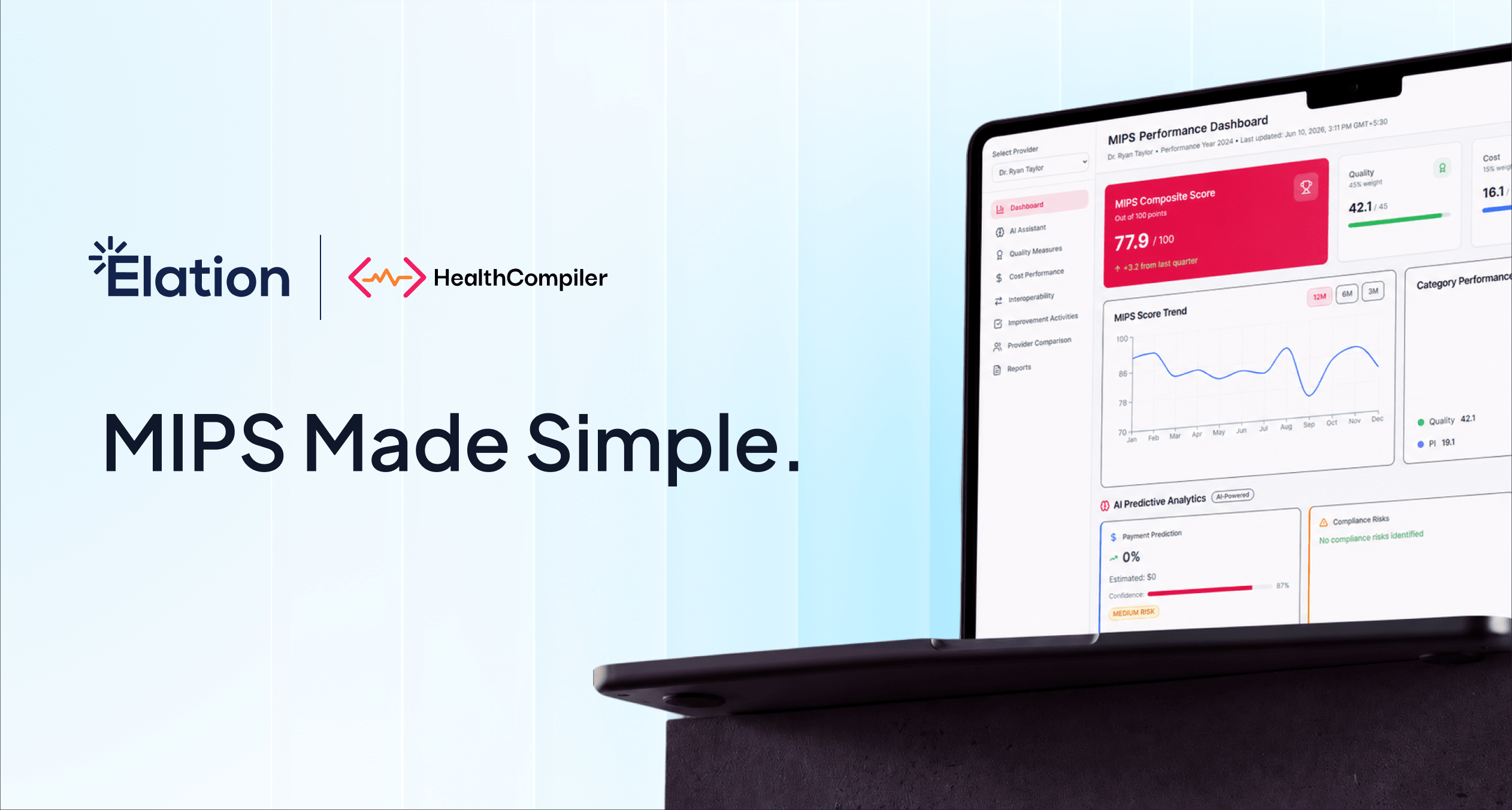
On top of that, Health Compiler set up a dashboard that auto-calculated performance across the relevant cardiology quality measures per CMS specifications. The practice moved from quarterly spreadsheet reviews to a real-time view of where each provider stood across Quality, Promoting Interoperability, Improvement Activities, and Cost.
The combination gave the clinic two things it did not have before: complete data capture from Elation's clinical record, and a live performance view that clinicians and practice leadership could act on during the year rather than after it.
What the Practice Saw
With more complete data flowing into the calculations and real-time dashboards in place, the practice's MIPS scores began reflecting the care that was actually being delivered. The penalty risk that had been a concern was no longer on the table.
Beyond that, the provider-level visibility became a useful tool for the practice. Rather than looking at aggregate numbers once a year, the clinic could see where each provider was strong and where there were opportunities to improve. One cardiologist might be performing well on medication management measures but have room to tighten up documentation on referral follow-through. That kind of insight is difficult to get from a manual process, and it gave the practice a way to think about quality improvement on an ongoing basis.
There was also a practical benefit for clinical staff. The re-documentation work that had been part of the old process, going back through charts to re-enter information into structured fields so reporting would capture it, was no longer necessary. Elation's clinical workflow stayed intact, and Health Compiler worked with the data as it was.
Looking Ahead
MIPS continues to evolve for cardiology. CMS has introduced cardiology-specific MIPS Value Pathways, and the Ambulatory Specialty Model will bring additional layers of measurement for specialty practices. The reporting requirements are not getting simpler.
For practices on Elation Health, the clinical documentation is already in good shape. Pairing that with a reporting layer that can work with the full depth of what clinicians write, structured and unstructured, creates a workflow where strong clinical care translates directly into accurate performance measurement.
Bringing It Together
This was a practice that was already doing the work. The combination of Elation's clinical record and Health Compiler's data platform simply made sure that work got counted. The clinicians did not have to change how they practiced. The reporting just got better at keeping up with them.
For specialty practices navigating MIPS, it is worth asking whether your current reporting captures everything your clinicians are documenting. The answer to that question often explains the gap between the care being delivered and the scores being reported.